
Views: 0 Author: Site Editor Publish Time: 2026-09-07 Origin: Site


Medical adhesive manufacturing carries high stakes. Microscopic inconsistencies in coat weight cause product failures, skin trauma, and immediate regulatory recalls. Production engineers face a constant battle. You must maximize throughput while maintaining strict precision, tension control, and cleanroom standards for surgical tapes, wound dressings, transdermal patches, and ECG electrodes. This guide provides an evidence-based framework to evaluate, shortlist, and validate a medical tape coating machine that aligns with specific operational and compliance requirements. We will break down core technologies, equipment architecture, and GMP standards so you can secure machinery that guarantees flawless performance and regulatory approval on the factory floor.
Technology Matching: Selecting between hot melt, solvent-based, or UV-curable systems dictates the machine's architecture, footprint, and suitable applications (e.g., zinc oxide vs. acrylics).
Precision is Non-Negotiable: High-end medical tape coating equipment relies on intelligent PID temperature control and advanced slot-die or roll-coating heads to maintain strict GSM (Grams per Square Meter) tolerances and a seamless finish.
Regulatory Baseline: True medical-grade machinery must be designed for GMP compliance, featuring sanitary construction, cleanroom compatibility, and comprehensive data logging for audit trails.
Handling medical substrates requires absolute mechanical precision. Materials like ultra-thin polyurethane (PU) films and lightweight non-wovens stretch, wrinkle, or tear under improper tension. A high-quality medical tape production machine utilizes closed-loop tension control systems. These systems rely on precision load cells and low-inertia dancer rollers to monitor web tension constantly. The data feeds back to a central PLC, which instantly adjusts the torque of the unwind servo motors.
When running a 15-micron PU film, even a slight tension spike causes necking, where the web narrows and distorts. Magnetic powder brakes often lack the response time needed for these fragile materials, making AC vector drives or servo motors mandatory. Web alignment is equally critical. Edge Position Control (EPC) or Line Position Control (LPC) systems use ultrasonic or optical sensors to detect the edge of the substrate. If the material drifts, the system physically shifts the unwind carriage to keep the web perfectly centered before it enters the coating station. This prevents adhesive from spilling onto the machine rollers and ensures a clean edge for downstream processing.
The coating head dictates the minimum and maximum coat weights achievable, as well as the uniformity of the adhesive layer. Two primary architectures dominate the medical sector. Slot die coating pumps adhesive through a precisely machined metal die directly onto the substrate. It is ideal for exact, uniform applications and pattern coating. Slot dies excel at maintaining tight GSM tolerances, making them the standard for transdermal patches and advanced wound care. The internal manifold of the die distributes the fluid evenly across the entire width, compensating for pressure drops.
Roll coating configurations like comma rolls or reverse rolls handle different adhesive viscosities. A comma roll uses a precisely ground blade to meter the adhesive thickness on a backing roll before transferring it to the web. This is highly effective for thicker, high-viscosity formulations like heavy zinc oxide adhesives used in rigid sports tapes. Reverse roll coaters utilize three or four rollers running in opposite directions to wipe a precise layer of adhesive onto the substrate, offering excellent control for medium-viscosity solvent acrylics.
Coating Method | Viscosity Range | GSM Tolerance | Best Medical Applications |
|---|---|---|---|
Slot Die | Low to High (1,000 - 100,000 cps) | ± 0.5 to 1.0 GSM | Transdermal patches, hydrocolloids, pattern coating |
Comma Roll | Medium to High (10,000 - 80,000 cps) | ± 2.0 to 3.0 GSM | Zinc oxide tapes, heavy surgical tapes, rigid strapping |
Reverse Roll | Low to Medium (500 - 20,000 cps) | ± 1.0 to 2.0 GSM | Solvent acrylics, breathable non-woven dressings |
Once the adhesive is applied, it must be stabilized immediately. The method depends entirely on the adhesive chemistry. For hot melt systems, chilling rollers are mandatory. These double-jacketed steel rollers circulate chilled water or glycol to drop the temperature of the adhesive instantly. This sets the bond without transferring damaging heat to sensitive substrates like thin PE films. Factory humidity plays a role here; if the chilling roller is too cold, condensation forms on the surface, introducing moisture into the medical tape and ruining the adhesive tack.
Solvent or water-based acrylics require multi-zone drying ovens. These ovens must provide uniform airflow and precise temperature gradients. If the temperature is too high initially, the surface of the adhesive skins over, trapping solvents underneath and causing blisters. Multi-zone systems gradually increase the heat, ensuring complete evaporation of the carrier fluid. Exhaust management is critical. The ovens utilize variable frequency drive (VFD) fans to maintain negative pressure, pulling volatile organic compounds (VOCs) out of the chamber and directing them to thermal oxidizers or recovery units.
Most medical tapes require a release liner to protect the adhesive until application. This necessitates an inline lamination process. A medical tape laminating machine module merges the coated substrate with a silicone-coated paper or film liner. The lamination nip utilizes two precision-ground rollers, typically one steel and one rubber-coated.
Pressure control mechanisms at this stage are vital. Pneumatic or hydraulic cylinders apply exact, even pressure across the entire width of the web. If the pressure is uneven, air bubbles become trapped between the tape and the liner, compromising the product's sterility and aesthetic appeal. The durometer (hardness) of the rubber roller is carefully selected based on the fragility of the medical substrate. A softer rubber (e.g., 60 Shore A) conforms better to textured non-wovens, while a harder rubber (e.g., 80 Shore A) provides the rigid nip required for flat PET films. Deflection is a major concern on wide webs; crowning the rubber roller slightly in the center compensates for the natural bowing of the steel shaft under pressure.
The final stage transforms wide master rolls into manageable formats. Large industrial slitting mechanisms cut the web into specific widths. Shear slitting uses overlapping circular blades like scissors and provides clean cuts for non-wovens and fabrics. Razor slitting is often preferred for thin plastic films, though the blades dull quickly and require frequent replacement. Dust generation during slitting is a massive issue for cleanroom environments, requiring localized vacuum extraction hoods right at the blade interface.
Rewinding requires isolated tension zones. As the roll diameter increases, the tension must taper off to prevent the inner layers from telescoping or crushing. Producing neatly wound, clean, roll-like bundles prevents edge contamination. Differential friction shafts are standard on high-end machines. These shafts allow individual rewind cores to slip independently, compensating for minor gauge variations across the width of the web and ensuring every finished roll has identical density.
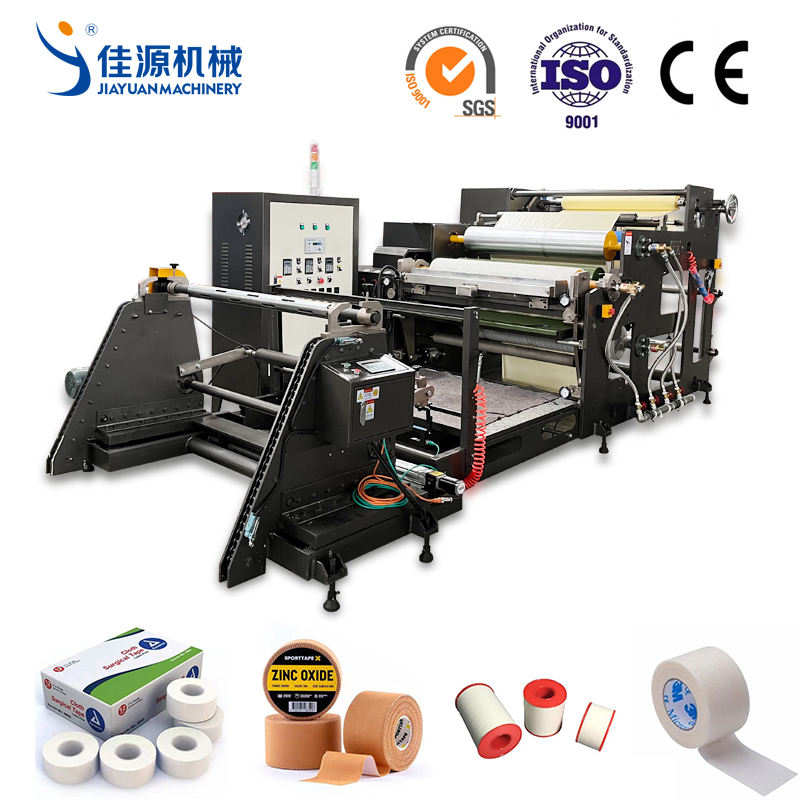
Thermoplastic adhesives, such as synthetic rubber or specific zinc oxide formulations, require specialized handling. A hot melt coating machine for medical tape operates by melting solid adhesive blocks in a heated tank. Precision gear pumps then push the molten fluid through heated hoses into the extrusion die.
These systems achieve high line speeds and produce zero VOC emissions. Because they do not require massive drying ovens, the machine footprint is significantly smaller. They are ideal for heavy-duty surgical tapes, athletic tapes, and specific absorbent wound dressings. The primary drawback is high thermal stress on the substrate. Applying adhesive at 150°C to 180°C can melt or distort thin plastic films. The system requires rigorous PID temperature control to prevent the adhesive from degrading, charring, or cross-linking inside the tank and hoses. Nitrogen blanketing inside the melter tank is often used to displace oxygen and prevent adhesive oxidation during long production runs.
Acrylic adhesives are renowned for their hypoallergenic properties and breathability, making them a staple in long-term wear medical applications. These systems apply liquid adhesives at room temperature. The coated web then passes through extensive drying ovens to evaporate the solvent or water carrier.
This technology is excellent for highly breathable tapes, IV securement dressings, and handling extremely heat-sensitive films. The room-temperature application prevents thermal distortion of the substrate. However, the equipment requires a massive factory footprint due to the length of the drying ovens. Energy consumption is high. For solvent-based systems, the facility must maintain strict explosion-proof (ATEX) ratings. All electrical components, motors, and sensors inside the coating zone must be intrinsically safe. Lower Explosive Limit (LEL) monitors are installed inside the ovens to shut down the line automatically if solvent vapor concentrations approach dangerous levels.
Technology Type | Application Mechanism | Ideal Medical Applications | Facility Requirements |
|---|---|---|---|
Hot Melt | Heated extrusion via slot die or roll | Heavy surgical tapes, athletic tape, rigid dressings | Small footprint, robust chilling systems needed, high electrical load for heaters |
Solvent-Based Acrylic | Liquid coating followed by thermal evaporation | Hypoallergenic tapes, IV dressings, breathable films | Large footprint, ATEX compliance, VOC recovery, thermal oxidizers |
Water-Based Acrylic | Liquid coating followed by thermal evaporation | Standard wound plasters, gentle skin tapes | Large footprint, high-capacity drying ovens, humidity control |
In medical manufacturing, the acceptable GSM variance is exceptionally tight. For standard surgical tape, a deviation of ±2 GSM might be acceptable. For transdermal patches delivering active pharmaceutical ingredients (APIs), the tolerance shrinks to ±0.5 GSM or less. A medical tape coating equipment setup must guarantee a seamless and uniform finish. Streaks, voids, or bubbles in the adhesive layer lead to inconsistent skin adhesion or erratic drug delivery rates.
To maintain this precision, advanced machines integrate automated coat weight measurement systems. Beta gauge scanners or X-ray sensors traverse the width of the moving web, measuring the exact thickness of the adhesive in real-time. This data feeds back to the coating head, automatically adjusting gear pump RPMs or motorized die lip gaps to correct any deviations instantly. This closed-loop feedback eliminates human error and drastically reduces scrap during startup.
Precise temperature management is critical, particularly in hot melt systems. Adhesive viscosity changes drastically with temperature fluctuations. If the temperature drops, the adhesive thickens, leading to heavy coat weights and poor substrate wet-out. If it overheats, the adhesive degrades and loses its tack.
Intelligent Proportional-Integral-Derivative (PID) controllers manage multi-zone heating systems. The melter tank, individual transfer hoses, and the coating head itself all require independent, highly accurate temperature zones. RTD (Resistance Temperature Detector) sensors provide continuous feedback, allowing the PID controller to pulse solid-state relays. This maintains the adhesive temperature within a ±1°C window across the entire fluid path. Advanced HMIs display real-time temperature trending graphs, allowing operators to spot failing heater cartridges before they impact product quality.
Manufacturers must tailor the machine's web width to specific production needs. Narrow web machines ranging from 300mm to 600mm feature cantilevered designs. These are ideal for high-value, low-volume products like transdermal patches or specialized hydrocolloids, allowing for rapid changeovers and minimal material waste. Wide web machines spanning 1000mm to 1600mm are built for bulk surgical tapes and high-volume commodity plasters.
Scalability is a crucial evaluation factor. Forward-thinking manufacturers opt for modular machine designs. A modular frame allows production engineers to add extra drying zones, integrate inline vision inspection systems, or upgrade UV curing lamps as the company's product portfolio expands. Flange-mounted idler rollers and pre-drilled side plates make future mechanical additions straightforward without requiring extensive field welding or machining.
Equipment manufacturers frequently advertise line speeds ranging from 10 to 150 meters per minute. Maximum mechanical speed rarely equals optimal production speed. Operational speeds are dictated by adhesive curing times, substrate fragility, and required inspection intervals.
Running a heavy solvent-based adhesive at 100m/min will likely result in incomplete drying, causing the rolls to block and stick together in storage. Running a stable hot melt on a robust cotton substrate can easily sustain 120m/min. Engineers must calculate realistic operational speeds by matching the drying or cooling capacity of the machine to the specific chemistry of the adhesive. Dwell time inside the oven is a fixed mathematical equation based on oven length and web speed; pushing the speed beyond the oven's evaporative capacity guarantees product failure.
Medical tapes utilize a vast array of substrates. A single facility might process rigid cotton cloth, highly elastic non-wovens, perforated polyethylene (PE), and ultra-thin polyurethane (PU) films. The coating machine must handle these diverse materials without causing distortion.
Switching between substrates requires mechanical adjustments. Operators must recalibrate tension zones, swap out idler rollers, and adjust nip pressures. Using low-friction Teflon-coated rollers prevents sticky materials from wrapping around the shafts. Machines equipped with recipe-driven HMI systems allow operators to recall exact tension and speed parameters for different substrates instantly. This reduces reliance on operator tribal knowledge and ensures consistent setups across different shifts.
Medical-grade machinery must adhere to Good Manufacturing Practice (GMP) standards. This begins with sanitary design. All contact parts, and often the entire machine frame, must be constructed from 304 or 316L stainless steel. The surface roughness (Ra) must be polished below 0.8 micrometers to prevent bacterial adhesion and allow for effective wipe-downs with isopropyl alcohol or sporicidal agents.
Engineers must eliminate dead legs. Crevices, exposed threads, or flat horizontal surfaces where dust, adhesive residue, or contaminants can accumulate are unacceptable. For integration into ISO-rated cleanrooms, the machine design must be enclosed. Servo motors, pneumatic cylinders, and drive belts are sealed behind smooth guarding to prevent particulate generation from contaminating the cleanroom environment. Exhaust fans on the electrical cabinets must feature HEPA filters to maintain cleanroom air quality.
Regulatory bodies like the FDA require strict documentation of the manufacturing process. The machine's PLC/HMI systems must record all critical operational parameters, including temperature, line speed, web tension, and alarm states.
To comply with FDA 21 CFR Part 11, these records must feature secure, unalterable audit trails. The system requires hierarchical user access levels protected by passwords or biometric scans. Operators can start and stop the machine, but only engineers can change PID tuning parameters. Electronic signature capabilities ensure that any change to a production recipe or acknowledgment of a critical alarm is permanently logged to a specific user with a time and date stamp.
Procuring medical equipment involves a rigorous validation lifecycle. It begins with Factory Acceptance Testing (FAT) at the OEM's facility, where the machine is run using actual production materials to verify baseline performance. This is followed by Site Acceptance Testing (SAT) once the machine is delivered and integrated into your cleanroom.
The formal validation process includes Installation Qualification (IQ), Operational Qualification (OQ), and Performance Qualification (PQ). Procurement contracts must stipulate that the OEM provides comprehensive documentation packages. This includes material certificates for all stainless steel, electrical schematics, pneumatic diagrams, and detailed testing protocols to support the validation process. Without this documentation, passing a regulatory audit is impossible.
Two of the most common production risks are adhesive penetrating porous substrates and fragile webs snapping under tension. Bleed-through ruins the aesthetic of the tape, destroys the release liner functionality, and causes massive scrap rates. Web breaks result in significant machine downtime as operators re-thread the line.
Specify precision tension zones that isolate the unwinding, coating, and rewinding stages. Utilize low-friction idler rollers and optimize the adhesive rheology. Adjusting the viscosity and application temperature prevents the adhesive from striking through non-woven materials while maintaining surface tack. Using a transfer coating method, where the adhesive is coated onto the release liner first and then laminated to the non-woven, completely eliminates bleed-through risks.
Switching between product lines can result in excessive lost production hours. Cleaning coating heads, purging adhesive hoses, and threading new substrates consume valuable time on the factory floor.
Evaluate machines designed with Single-Minute Exchange of Die (SMED) principles. Look for quick-change coating modules that slide out on precision rails, allowing operators to swap a slot die for a comma roll in minutes. Automated recipe management in the HMI reduces setup errors. Accessible purge and clean-out designs in the melter tanks allow operators to flush the system rapidly without dismantling heavy components.
Extended machine downtime often stems from a reliance on proprietary, hard-to-source components. If a custom circuit board fails and the OEM has a six-week lead time, production halts completely.
Prioritize a medical adhesive tape coating machine built with globally available, non-proprietary components. Ensure the PLC, servo drives, pneumatics, and sensors are sourced from standard industrial brands like Siemens, Allen-Bradley, Festo, or SMC. This guarantees that your maintenance team can source replacement parts from local distributors immediately, keeping your production line running without relying on overseas shipments.
Define your adhesive technology based on the clinical requirements and substrate compatibility of your final product.
Draft a rigorous User Requirement Specification (URS) document detailing your acceptable GSM variances, tension control needs, and CFR 21 Part 11 data logging requirements.
Request pilot-scale trials with the shortlisted manufacturers using your actual production substrates and adhesives to verify real-world performance.
Verify the global availability of all critical electronic and pneumatic spare parts used in the machine's construction to prevent future downtime.
A: Speeds range from 10m/min for highly specialized, thick coatings or fragile transdermal patches, up to 150m/min for standard, high-volume surgical tapes. The actual operational speed depends heavily on the adhesive curing time, oven capacity, and the mechanical stability of the substrate.
A: A slot die extrudes adhesive through a closed, precisely machined metal lip directly onto the web, offering superior GSM control and pattern capabilities. Roll coating uses open rollers to meter and transfer the adhesive, which suits very high-viscosity formulations like heavy zinc oxide.
A: Polyurethane (PU) films used in medical dressings are often thinner than 20 microns and highly elastic. Without closed-loop tension control utilizing load cells and servo motors, the film stretches during coating. Once the tension releases, the film retracts, causing the adhesive layer to wrinkle and fail.
A: GMP compliance requires sanitary construction using 304/316L stainless steel, elimination of dead legs where bacteria can harbor, and enclosed mechanical systems to prevent cleanroom contamination. It also mandates comprehensive data logging with secure audit trails for quality control and traceability.
A: Generally, no. The architectures are fundamentally different. Hot melt requires heated tanks, heated hoses, and chilling rollers. Solvent-based systems require room-temperature application heads, massive thermal drying ovens, and explosion-proof safety ratings. Combining both into one frame is highly impractical and inefficient.
A: Coat weight is measured continuously using inline scanning systems. Beta gauge or X-ray sensors traverse the moving web, measuring the mass or thickness of the adhesive layer. This data feeds back to the PLC to automatically adjust pump speeds or die gaps in real-time.


