
Views: 0 Author: Site Editor Publish Time: 2026-10-04 Origin: Site


Are defects ruining your pressure-sensitive adhesive products? Poor gap control causes costly production failures. Precision is vital for any hot melt application. The global manufacturing landscape is currently experiencing a massive shift toward solvent-free, eco-friendly processes. This shift has dramatically accelerated the adoption of hot melt technologies.
Recent industry analyses highlight a critical evolution in the coating sector. As demand surges for ultra-thin, high-performance tapes in the electronics, automotive, and medical device sectors, manufacturers face unprecedentedly tight tolerances. The market is rapidly moving away from traditional solvent-based methods due to stringent environmental regulations. Consequently, hot melt slot die technology has become the industry standard for achieving zero-emission, high-precision coatings. This trend underscores a stark reality. Mastering fluid dynamics is no longer optional; it is a baseline requirement for survival in a highly competitive market.
In this comprehensive guide, we cover die setup and bead management. Master these fundamental mechanics to optimize your coating line, minimize downtime, and drastically reduce material waste.
The Coating Gap: Achieving micron-level precision when setting the distance between the die lip and the substrate is non-negotiable. This single variable dictates coat weight uniformity, shear rates, and the overall structural integrity of the final product.
The Coating Bead: The fluid dynamic bridge must maintain a stable internal pressure and shape. Proper management prevents critical quality defects, including adhesive skipping, bleeding, and air entrainment.
Operational Stability: High-speed production demands rigid infrastructure. Managing mechanical variables, thermal expansion, and vibration across your machinery is essential to maintain a delicate process balance.
Troubleshooting Efficiency: Recognizing the physical symptoms of coating failures allows operators to trace issues back to their root causes, whether mechanical, rheological, or procedural.
To achieve consistent results in pressure-sensitive adhesive manufacturing, operators must first understand the fundamental mechanics of a hot melt adhesive coating system. The slot die process operates as a pre-metered coating method. The amount of fluid applied to the substrate is determined entirely by the fluid delivery rate and the substrate speed. This remains independent of other variables, provided the coating bead remains stable.
The core components of this infrastructure include the fluid delivery pump, heated hoses, and the slot die itself. Inside the die, a manifold distributes the highly viscous hot melt adhesive evenly across the desired width. A precision-cut metal shim dictates the baseline thickness and width of the fluid exiting the die lips. However, the physical hardware is only part of the equation. The actual application relies on two critical spatial and fluid-dynamic concepts.
First is the coating gap. This strictly measured physical distance resides between the outermost edge of the die lip and the surface of the moving substrate. A backing roll usually supports this substrate. In thin-film applications, engineers typically measure this gap in microns. It acts as the mechanical boundary defining the maximum allowable thickness of the fluid before compression or stretching occurs.
Second is the coating bead. This pressurized, continuous volume of liquid adhesive bridges the space between the die lip and the substrate. It is not a static object. Rather, it is a highly dynamic fluid meniscus governed by pump pressure, fluid viscosity, surface tension, and web speed. The relationship between the static gap and the dynamic bead forms the absolute heart of the slot die process. If the clearance is incorrect, the bead cannot stabilize. Conversely, if the bead collapses, the mechanical precision becomes irrelevant.
In pre-metered slot die coating, the gap serves as the most critical mechanical variable. It directly influences the fluid shear rate and the pressure drop across the die lips. Even microscopic deviations here can lead to macroscopic failures on the production floor.
The gap size directly interacts with the rheology of the hot melt adhesive. Pressure-sensitive adhesives are typically non-Newtonian fluids. Their viscosity changes under shear stress. When the clearance is set too tight, the shear rate spikes. This intense stress can potentially degrade the polymer chains within the adhesive, permanently altering its tack and peel properties. On the other hand, if the distance is too wide, the pressure within the coating bead drops. This leads to a loss of fluid control and results in uneven coat weights across the web.
Picture an operator setting a gap at 100 microns on a cold machine. Once the 180-degree Celsius adhesive flows, thermal expansion swells the steel die and surrounding machinery. That gap shrinks to a restrictive 50 microns. The result is unpredictable coat-weight drift and a ruined batch of material. If the system is not properly calibrated at operating temperature, the application dynamics change drastically. This causes uneven web tension as the substrate is pulled through a tighter clearance.
Maintaining a consistent gap during high-speed operation requires rigorous mechanical protocols. Engineers utilize precision dial indicators and laser micrometers to map the profile across the entire web. Specifically, managing the Total Indicator Runout of the backing roll is crucial. Imagine walking down the line and hearing the distinct chatter of a vibrating machine. If the backing roll is slightly eccentric, the gap will continuously fluctuate with every rotation. This creates a repeating pattern of thick and thin adhesive layers.
While the gap serves as a mechanical boundary, the coating bead represents a delicate fluid-dynamic balancing act. The physics dictate that it must remain stable, continuous, and firmly pinned to the edges of the die lips to produce a flawless adhesive layer.
The bead consists of an upstream meniscus facing the incoming dry substrate and a downstream meniscus facing the coated substrate exiting the die. For stability, the internal pressure of the fluid must perfectly counteract atmospheric pressure and the drag forces exerted by the moving web. If the internal pressure is too low, the upstream meniscus retreats into the die vacuum. This pulls air into the fluid. In contrast, if the pressure is too high, the fluid breaches the downstream meniscus and spills out uncontrollably.
Hot melt adhesives exhibit varying viscosities depending on their specific formulation and temperature. Rubber-based adhesives behave differently than acrylic-based alternatives. Operators must continuously monitor the volumetric flow rate of the pump to match the fluid viscosity at the operating temperature. A highly viscous adhesive requires higher manifold pressure to maintain the bead. Consequently, the pump speed must be carefully calibrated against the substrate line speed.
A failing bead presents immediate visual symptoms on the production line. Tailing or ribbing occurs if the bead pressure is too low relative to the web speed. The adhesive will not release cleanly from the die lip, creating longitudinal lines. Edge build-up happens when manifold pressure is uneven, causing the bead to bulge at the edges. Finally, starvation takes place when flow rates drop below the minimum threshold required to bridge the gap. This ruptures the bead and leaves bare patches. Responding to these failures requires immediate, calculated adjustments to pump speed, web tension, or the die-to-roll distance.
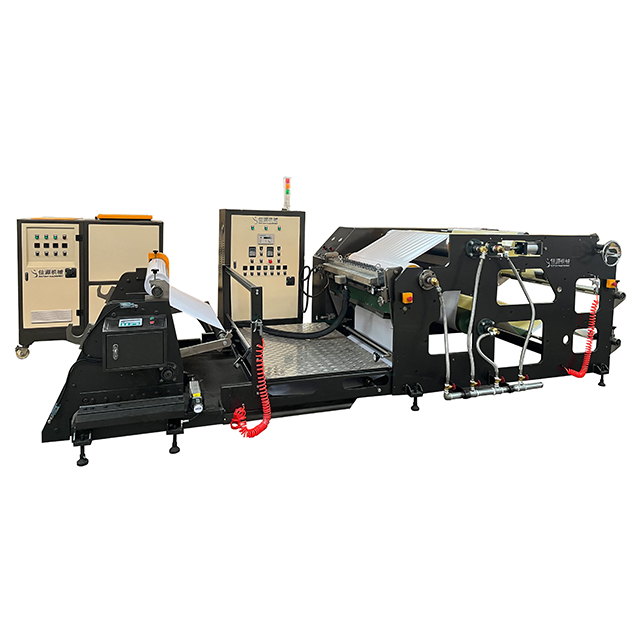
Achieving a uniform adhesive layer is not solely dependent on the die itself. The mechanical framework supporting the die is equally critical. The integration between the slot die head and the overall machinery determines whether theoretical coating parameters can be maintained in a dynamic, high-speed production environment. A high-quality slot die laminating machine provides the necessary structural rigidity to prevent micro-vibrations. These vibrations are a primary cause of transverse coat weight variations.
In thin-film adhesive applications, the coating gap may be as narrow as 50 microns. Even a 5-micron deflection in the machine frame can result in a significant variation in coat weight. To mitigate this, industrial-grade equipment utilizes heavy-duty side frames and vibration-damping mounting brackets. Furthermore, the backing roll must exhibit exceptional concentricity. The runout of the backing roll should ideally be kept below 2 to 3 microns to prevent the gap from oscillating.
A stable coating bead requires a stable substrate. Fluctuations in web tension can cause the substrate to pull away from or push into the die lip. This instantaneously alters the effective clearance. Modern equipment employs closed-loop tension control systems utilizing load cells and servo-driven nip rollers. This ensures the substrate remains perfectly taut and flat as it passes the die lip. It safeguards the integrity of the coating bead during high-speed runs.
Hot melt adhesives are highly sensitive to temperature variations. A temperature drop of just a few degrees can exponentially increase the adhesive viscosity. This leads to higher internal die pressure and potential bead starvation. An optimized system integrates multi-zone PID temperature controllers. These controllers maintain uniform heat distribution across the melting tank, the heated hoses, and the die head itself. This prevents thermal expansion anomalies in the steel die lip.
Transitioning from theoretical parameters to active production requires a methodical setup process. Establishing a standardized operating procedure for your system minimizes startup waste. It also prevents catastrophic damage to the precision-ground die lips.
To achieve a stable process window, operators should adhere to a strict calibration sequence before introducing the adhesive to the substrate.
Thermal Stabilization: Heat the system to the target operating temperature and allow it to soak for at least 45 minutes. Thermal expansion will alter the die gap. Calibrating on a cold die will result in severe inaccuracies during operation.
Shim Inspection: Verify that the stainless steel shim is perfectly clean, free of micro-kinks, and properly aligned with the die lips. The shim dictates the coating width and influences the internal pressure drop.
Gap Calibration: Use precision feeler gauges to set the initial clearance. Measure at the center and both edges to ensure the die is perfectly parallel to the backing roll.
Pump Calibration: Calculate the required pump RPM based on the target coat weight, line speed, and adhesive density.
Purging: Extrude a small amount of adhesive off-web. This purges any degraded material or trapped air from the manifold.
Once initial parameters are set, operators must verify that the adhesive is adequately wetting out on the substrate. Wet-out refers to the ability of the fluid to flow and establish intimate contact with the micro-surface of the substrate. If the surface energy of the material is too low relative to the surface tension of the adhesive, the coating bead will retract. This causes pinholing or edge recession. Conducting a brief test run at low speed allows operators to inspect the wet-out behavior under magnification.
The operational lifespan of your equipment heavily relies on systematic maintenance. Any scoring from abrasive contaminants or improper cleaning tools will permanently alter the coating profile. Always use brass or copper tools when cleaning the die face. Never use steel. In addition, schedule regular flushes of the melting tank and hoses with approved purging compounds. This prevents the buildup of cross-linked or charred adhesive.
Even with meticulous setup, process variables can drift. This leads to coating defects. Rapid identification and correction of these anomalies are crucial for maintaining throughput and minimizing scrap. Below is a detailed breakdown of common defects associated with bead and gap mismanagement.
Stripping or skipping indicates a fundamental failure of the coating bead. This occurs when the vacuum forces holding the bead against the upstream die lip are broken. Air becomes entrained in the adhesive. Often, the line speed has exceeded the critical capillary number for the fluid viscosity, or the clearance is too wide. Decreasing the distance by 10 to 20 micron increments to increase bead pressure usually resolves this issue.
If the edges of the adhesive coating are undulating or bleeding outside the target width, the internal pressure distribution within the die is unbalanced. This is typically caused by excessive pump flow relative to the line speed. An improperly cut shim that creates turbulent flow at the edges can also be the culprit. It can also be triggered by a gap that is too tight, forcing the adhesive to seek the path of least resistance laterally.
Defect Symptom | Primary Root Cause | Recommended Solution |
|---|---|---|
Air Bubbles / Voids | Moisture in adhesive or air entrainment at upstream meniscus. | Check tank seals; adjust die attack angle to seal the bead; ensure proper degassing time. |
Heavy Edges | Excessive manifold pressure at die ends. | Modify shim geometry; verify adhesive temperature and viscosity. |
Chatter Marks | Mechanical vibration or web tension fluctuations. | Check backing roll runout; tune PID tension controllers; isolate machine vibration. |
Coat Weight Drift | Thermal expansion altering the gap over time. | Allow full thermal soak before calibration; utilize closed-loop thickness measurement systems. |
As production demands scale and adhesive formulations become more complex, legacy equipment often becomes the bottleneck. Recognizing the operational limits of your current machinery is the first step toward achieving higher profitability and tighter quality control.
Older coating lines frequently rely on manual gap adjustments and open-loop tension systems. These manual interventions introduce human error and require significant downtime for changeovers. Furthermore, legacy melting tanks often suffer from poor thermal distribution. This leads to localized hot spots that degrade temperature-sensitive adhesives. If your facility is experiencing reject rates above 3 percent, or if operators are constantly tweaking parameters to maintain a stable coating bead, the equipment is likely operating outside its intended capability limits.
Transitioning to modern technology fundamentally shifts the process from reactive troubleshooting to proactive quality control. Advanced systems incorporate motorized die positioners with micron-level accuracy. This allows for instantaneous, repeatable gap adjustments without stopping the line. Integration with closed-loop coat weight measurement systems enables the machine to autonomously adjust pump speeds in real-time. This completely eliminates coat-weight drift.
For facilities looking to maximize throughput while maintaining stringent quality standards, investing in an advanced hot melt slot die coating machine provides a direct path to process stability. For example, industry-leading models feature maximum mechanical speeds up to 200 meters per minute and support coating widths from 400mm to 2500mm. These integrated systems are engineered with advanced vibration damping, precise thermal fluid dynamics, and automated tension control. This ensures that the coating bead remains perfectly stable even at maximum production speeds. Upgrading reduces material scrap, lowers operator dependency, and significantly improves overall equipment effectiveness.
Machine precision and process control rely on a symbiotic relationship. A high-performance slot die is only as effective as the mechanical framework supporting it and the operator configuring it. Mastering the die gap and bead dynamics ensures superior product quality. It minimizes the risk of costly defects like skipping, bleeding, or coat-weight drift.
We encourage you to audit your current system settings today. By implementing rigorous setup protocols and recognizing the physical symptoms of fluid dynamic failures, you can achieve immediate performance improvements. When legacy equipment limits your potential, exploring advanced, automated solutions will pave the way for more reliable, high-speed production. For a tailored upgrade path, visit JY-WELL to explore equipment that matches your precise manufacturing requirements.
There is no universal measurement, as the ideal gap depends entirely on the adhesive viscosity, the line speed, and the target wet coat weight. However, for most standard applications, the gap typically ranges between 50 and 200 microns. A general engineering rule of thumb is to set the coating gap to approximately 1.5 to 2 times the desired wet film thickness. If the gap is too large, the coating bead loses pressure and breaks. If it is too small, excessive shear stress can degrade the adhesive and damage the substrate.
Temperature directly dictates the viscosity of hot melt adhesives. Higher temperatures lower the viscosity, making the adhesive more fluid. While this can help achieve thinner coat weights, it also makes the coating bead highly susceptible to pressure fluctuations. If the temperature is too high, the internal die pressure drops, causing the bead to destabilize and leading to edge bleeding or starvation. Conversely, temperatures that are too low will spike the internal pressure, potentially causing the die lips to deflect or the adhesive to skip across the substrate.
Edge bleeding is almost always a symptom of excessive internal die pressure finding the path of least resistance. This occurs when the coating gap is set too tight for the volume of adhesive being pumped, or when the adhesive viscosity is too low for the current shim geometry. To resolve this, verify that your pump RPM matches your target coat weight. If the math is correct, try opening the die gap by 10 microns to relieve backpressure, or use a shim with a slightly wider setback to control the lateral flow.
Not necessarily. While slot dies are highly versatile, the internal manifold design is engineered for a specific rheological window. A die designed for low-viscosity UV-cured acrylics will struggle to evenly distribute high-viscosity rubber-based hot melts, often resulting in heavy centers or starved edges. Facilities running drastically different adhesive chemistries may require interchangeable die heads or custom-engineered manifolds to ensure uniform fluid distribution across the entire web width.
Calibration frequency should be dictated by runtime hours and the specific chemistry of the adhesive. If you are running highly abrasive adhesives, the die lips may experience micro-wear and require calibration checks weekly. For standard unfilled adhesives, a thorough calibration and gap check should be performed during every major changeover or at least once a month. Preventive maintenance and routine calibration are far more cost-effective than running out-of-spec products.
Accurate measurement requires the system to be fully heated to its operating temperature to account for thermal expansion. Engineers typically use precision brass feeler gauges for initial physical checks, measuring at the center and both edges of the die lip to ensure parallel alignment with the backing roll. For dynamic, real-time measurement during production, advanced lines utilize laser micrometers or ultrasonic sensors that continuously monitor the gap without contacting the wet adhesive.
Air entrainment typically occurs when the upstream meniscus of the coating bead destabilizes. If the web speed is too fast relative to the fluid viscosity, or if the pump pressure is too low, the vacuum holding the bead to the die lip breaks. This allows ambient air to be pulled under the adhesive layer, resulting in bubbles, voids, or skipping defects. Adjusting the die attack angle, reducing the coating gap to increase bead pressure, or optimizing the line speed usually resolves this issue.


