
Views: 0 Author: Site Editor Publish Time: 2026-07-01 Origin: Site


Industrial lamination upgrades require precise equipment selection to maintain operational efficiency on the factory floor. Material waste, production speed, and overall product quality hang in the balance when integrating new machinery into an existing web handling process. Traditional solvent-based and water-based systems carry high environmental compliance burdens. They demand extensive drying times, consume massive amounts of energy through forced-air ovens, and require complex exhaust handling. Transitioning to 100% solid hot melt technologies solves these critical production bottlenecks directly. Selecting the right hot melt glue laminating machine requires matching specific coating technologies, such as slot die or roller applications, directly to your substrate types and daily production volume. You must evaluate core machine features, compare application methods, and effectively vet equipment suppliers to ensure a successful installation.
Technology Shift: Hot melt systems eliminate the need for drying ovens, significantly reducing the production footprint and energy costs while ensuring eco-friendly compliance.
Application Precision: Advanced configurations, particularly slot die coating, offer exact control over coating weights, minimizing adhesive waste and preventing substrate distortion.
Supplier Vetting: Long-term operational success relies heavily on the supplier’s ability to provide robust Factory Acceptance Testing (FAT), operator training, and reliable spare parts availability.
Implementation Focus: Successful integration requires strict attention to tension control systems, heating uniformity, and facility readiness.
Defining the baseline metrics for a successful lamination process establishes clear production goals before any equipment is purchased. Bond strength, breathability, line speed, and defect rates determine the ultimate viability of your manufacturing output. Upgrading your equipment directly impacts these core performance indicators. Modern hot melt systems provide immediate improvements in consistency and output quality across diverse material runs, allowing operators to hit target metrics faster during startup.
Eliminating solvent-based bottlenecks transforms factory floor operations entirely. Removing massive drying tunnels drastically reduces facility energy consumption and frees up valuable floor space for secondary processes. It lowers VOC emissions, ensuring strict environmental compliance without expensive regenerative thermal oxidizers or air treatment systems. Hot melt adhesives cure rapidly upon cooling. This immediate bonding capability accelerates overall line speeds, often pushing production from 20 meters per minute to over 100 meters per minute, and reduces work-in-progress inventory sitting on the floor waiting to cure.
Material versatility remains a primary advantage of hot melt technology. These systems handle diverse materials seamlessly without the risk of solvent attack. Textiles, non-wovens, TPU films, and delicate aluminum foils process easily through the line. Solvent-induced degradation or warping becomes a non-issue. Operators can switch between heavy automotive fabrics and ultra-thin breathable medical films with minimal mechanical adjustments, relying on recipe-driven tension profiles.
Processing various hot melt formulations offers distinct operational advantages depending on the end-use application. Polyurethane Reactive (PUR) adhesives provide superior wash and heat resistance for demanding apparel, military gear, or automotive interior applications. Pressure Sensitive Adhesives (PSA) deliver excellent self-adhesive properties for industrial tapes, acoustic insulation panels, and labels. A versatile hot melt coating laminating machine adapts to these different adhesive chemistries, maximizing your production capabilities and allowing a single line to service multiple distinct markets.
Metric | Solvent-Based Systems | Hot Melt Systems |
|---|---|---|
Curing Mechanism | Evaporation via heated ovens | Rapid cooling via chill rollers |
Line Footprint | Extensive (requires long drying tunnels) | Compact (no ovens required) |
Environmental Impact | High VOC emissions, requires exhaust treatment | 100% solids, zero VOC emissions |
Energy Consumption | High (continuous oven heating) | Low (localized melting and chilling) |
Production Speed | Limited by drying tunnel length and temperature | High (limited only by mechanical web handling) |
Understanding primary application methods helps dictate specific industrial use cases. Equipment configurations vary widely based on the required coating precision, adhesive viscosity, and substrate characteristics. Selecting the appropriate application technology ensures optimal bond strength and minimizes raw material waste over thousands of production hours.
A slot die coating laminating machine utilizes closed-system extrusion mechanics. This method ensures completely streak-free adhesive application across the entire web width. It achieves ultra-low and highly precise coating weights, often down to 5gsm for lightweight films. The closed system inherently protects the molten adhesive against premature oxidation and ambient moisture exposure. Adjustable shims and rotating bar technology allow operators to make micro-grammage adjustments on the fly. These features protect highly scratch-sensitive substrates, such as optical films or metallized foils, during high-speed production runs by maintaining a precise fluid cushion between the die lip and the web.
Roller coating systems utilize engraved or anilox rollers to transfer adhesive from a heated bath to the substrate. They apply either full-surface coverage or specific dot-pattern coatings based on the engraving geometry. High-volume textile lamination and breathable fabric manufacturing benefit most from this setup, as the dot pattern maintains the fabric's natural drape and moisture vapor transmission rate (MVTR). Three-roll transfer systems offer different tension and application dynamics compared to direct gravure application configurations. Operators select the roller type and cell volume based on the required adhesive viscosity and desired fabric hand-feel.
Spray coating systems utilize non-contact fiber or spiral spray nozzles to atomize the hot melt. They generally yield lower overall bond strength compared to direct slot die methods because the adhesive cools slightly in the air before hitting the web. However, spray application remains ideal for highly heat-sensitive or physically irregular substrates like thick foams or lofty non-wovens. The non-contact nature prevents thermal damage to delicate films while maintaining adequate adhesion for disposable hygiene products, lightweight medical drapes, or acoustic insulation mats.
Multi-station and co-extrusion configurations handle complex composite structures efficiently. A multi-station adhesive coating production line processes multi-layer materials in a single, continuous pass. This eliminates the need for secondary processing steps, reducing labor and handling damage. It ensures perfect layer alignment and reduces total manufacturing time for advanced technical textiles, roofing membranes, or specialized packaging films that require distinct barrier and structural layers bonded simultaneously.
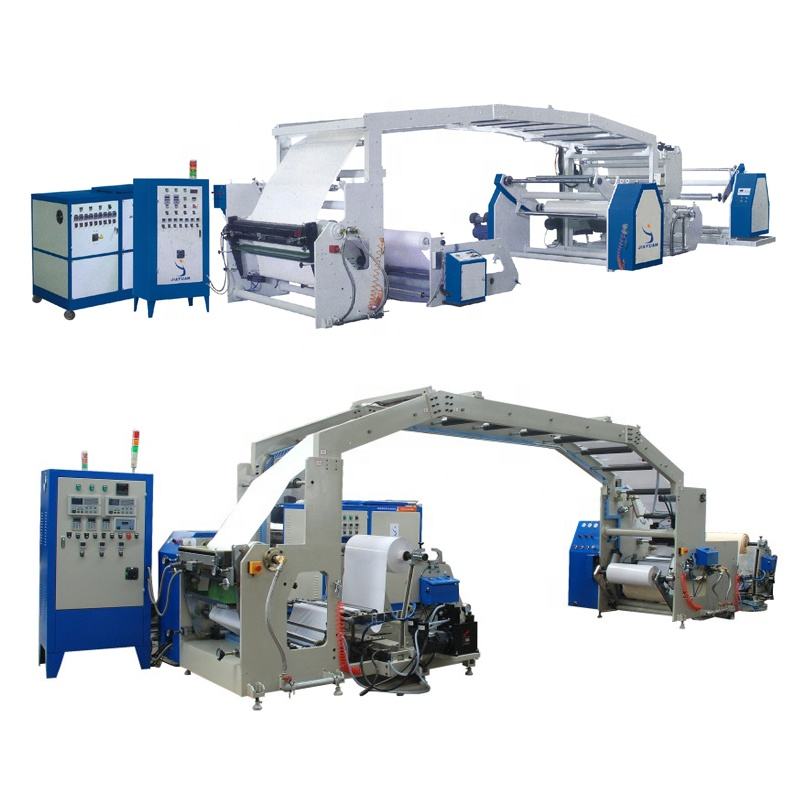
Mapping specific machine components to production outcomes clarifies the equipment evaluation process. Every mechanical and electronic feature must contribute directly to product quality, operational efficiency, or operator safety. A high-performance hot melt adhesive coating machine integrates precision controls across all processing zones, from the primary unwind to the final rewind.
Precision tension control systems prevent the wrinkling, stretching, or curling of materials. Thin films and elastic fabrics require multi-point, closed-loop tension control to survive the lamination nip without distortion. Load cells, magnetic particle brakes, AC vector drives, and dancer rollers maintain constant web stability. These components communicate continuously through the PLC to adjust tension dynamically as roll diameters change during unwinding and rewinding, ensuring the web remains flat and taut.
Web guiding and edge alignment systems ensure perfect edge-to-edge lamination. Electronic web guiding systems (EPC/LPC) integrate at critical unwind and rewind zones, utilizing ultrasonic or optical sensors. They detect lateral material shifts instantly and correct the web path via pivoting frames or shifting roll stands. This precision reduces edge trim waste, prevents adhesive bleed-over onto the machine rollers, and ensures uniform, telescope-free roll profiles at the rewind.
Automated coating weight measurement provides vital real-time feedback to the operator. Inline scanning technologies, utilizing beta, X-ray, or infrared gauges, monitor the applied adhesive layer continuously across the web width. They communicate directly with the adhesive dosing pump via a closed-loop PID controller. This feedback ensures consistent adhesive application, strictly controlling raw material consumption and alerting operators immediately if a nozzle clogs or a pump loses pressure.
Adhesive melting and delivery systems dictate operational uptime and adhesive integrity. Evaluate melt tank capacities and drum unloaders carefully based on your maximum line speed and coating weight. Continuous operations often require robust 55-gallon bulk systems with dual-pump configurations to allow drum changes without stopping the line. Grid melter designs improve melt rates significantly compared to smooth-tank designs. Moisture-protection systems, such as dry-nitrogen blanketing, are absolutely essential for preventing premature cross-linking and curing in reactive PUR adhesives before they reach the applicator head.
Heating and melting efficiency relies entirely on uniform temperature control. Multi-zone heating systems regulate temperatures independently across the melt tank, heated hoses, metering pumps, and applicator heads. This precise thermal management prevents adhesive degradation, viscosity fluctuations, and nozzle charring. A drop in temperature at the hose can spike viscosity, leading to uneven coating profiles and weak bonds.
Chilling and cooling rollers accelerate the solidification process immediately after the lamination nip. Integrated chill rolls, typically double-walled water-cooled drums, rapidly cool the adhesive layer prior to rewinding. This critical step prevents roll blocking, where the layers stick together in the finished roll, and eliminates adhesive bleed-through on porous substrates like lightweight non-wovens or open-weave textiles.
Surface pre-treatment modules modify substrate surface energy prior to coating. Integrating Corona treatment or atmospheric plasma systems ensures robust adhesion by oxidizing the surface and increasing its wettability. These treatments are necessary when processing difficult, low-surface-energy plastics like PP, PE, or PET films, ensuring the hot melt anchors deeply into the substrate rather than peeling off under stress.
HMI and PLC integration bring necessary data capabilities to the factory floor. Recipe storage enables rapid, error-free product changeovers by automatically recalling tension setpoints, temperature zones, and pump speeds. Real-time diagnostic alerts and comprehensive data logging ensure strict quality assurance, simplify troubleshooting procedures, and allow maintenance teams to track wear on critical components like pump seals and rotary unions.
Machine Component | Primary Production Outcome | Common Failure Mode if Substandard |
|---|---|---|
Closed-Loop Tension Control | Prevents film stretching and fabric wrinkling. | Web snapping, severe curling after lamination. |
EPC/LPC Web Guiding | Ensures perfect edge-to-edge alignment. | Excessive trim waste, adhesive on nip rollers. |
Inline Scanning Gauges | Reduces adhesive waste via real-time dosing. | Inconsistent bond strength, high adhesive costs. |
Integrated Chill Rollers | Prevents roll blocking and stops bleed-through. | Finished rolls fuse together in storage. |
Corona Pre-Treatment | Improves bond strength on low-energy plastics. | Adhesive delaminates easily from the film. |
Installing a continuous production line presents specific practical challenges that require rigorous project management. Facility readiness and mechanical synchronization dictate the success of the implementation phase. Proper planning mitigates costly installation delays, prevents utility shortfalls, and ensures a smooth transition to full production capacity.
Line synchronization isolates distinct web tension zones effectively. The unwinding, coating, laminating, cooling, and rewinding phases must operate independently yet synchronously. Advanced drive systems isolate these zones using driven nip rollers to prevent material distortion from propagating across the entire machine length. For example, the tension required to unwind a heavy textile is vastly different from the delicate tension required to pull a 10-micron breathable film through the coating head.
Facility requirements demand careful footprint and utility planning months before the machine arrives. Outline exact power requirements for high-draw melting units and multi-zone heated hoses. Establish proper ventilation needs for adhesive fumes, which are distinct from solvent extraction systems but still require localized exhaust hoods over the applicator head. Allocate sufficient physical space for dual unwinds, massive rewinds, and material accumulators to facilitate continuous flying splices without stopping the line.
Operator training mitigates inherent safety risks and operational errors on the floor. High-temperature equipment operating at 150°C to 200°C presents serious burn hazards requiring strict safety protocols and heavy-duty PPE. Lockout/tagout (LOTO) procedures protect maintenance staff during servicing of the nip rollers or die heads. Managing complex HMI recipes involves a specific learning curve that requires structured, hands-on training sessions focusing on threading the machine, calibrating load cells, and adjusting die shims.
Maintenance schedules dictate long-term equipment longevity and consistent product quality. Routine maintenance realities include strict purging procedures during shutdowns to prevent PUR adhesive from curing solid inside the hoses. Regular inline filter replacements and precise nozzle cleaning prevent costly unplanned downtime, eliminate coating streaks, and maintain consistent adhesive flow rates.
Verify incoming power drops match the total amperage draw of the melters, chillers, and main drives.
Install dedicated chilled water loops sized appropriately for the tonnage required by the cooling rollers.
Establish a localized exhaust system above the coating head to remove hot melt fumes and improve operator comfort.
Stock critical wear parts, including rotary unions, pump seals, and inline filters, prior to commissioning.
Develop standard operating procedures (SOPs) for safe die cleaning and adhesive purging.
Evaluating vendors requires looking far beyond the initial capital expenditure and glossy brochures. The reliability of the manufacturer directly impacts your daily production metrics and overall plant efficiency. A structured vetting process ensures you partner with a capable engineering team that understands your specific web handling challenges.
Factory Acceptance Testing (FAT) capabilities remain a critical evaluation metric. Emphasize the need to run your actual production substrates and specific adhesives on the machine at the supplier's facility. This physical proof-of-concept must occur before authorizing shipment. During the FAT, verify edge alignment accuracy, measure coating weight consistency across the web, and test the emergency stop integration.
Post-installation support determines your ability to maintain high uptime over the machine's lifespan. Evaluate the supplier's Service Level Agreements (SLAs) thoroughly. Verify their remote diagnostic capabilities for immediate software troubleshooting via secure VPN connections. A dependable hot melt laminating machine supplier guarantees the domestic availability of proprietary wear parts and rapid technician deployment when mechanical issues exceed your internal maintenance team's capabilities.
Customization versus off-the-shelf trade-offs require careful consideration based on your product roadmap. Standardized modular machines offer faster delivery timelines, proven mechanical reliability, and readily available spare parts. Conversely, custom-engineered lines handle highly specific multi-layer composites, integrate specialized surface treatments, or accommodate extreme web widths, but they require longer lead times and extensive testing phases to validate the custom engineering.
Compile your specific substrate samples, including maximum web widths, and define your required maximum line speeds.
Calculate your target coating weights and identify the exact adhesive viscosity ranges you intend to process.
Contact shortlisted equipment suppliers to schedule comprehensive proof-of-concept material trials using your actual production materials.
Prepare your facility layout, verifying power drops, chilled water capacity, and localized exhaust utility requirements for the new line.
A: Coating weights typically range from 5gsm for lightweight breathable films to over 50gsm for heavy industrial textiles. The exact range depends heavily on the applicator type, substrate porosity, and the specific adhesive viscosity being processed through the metering pump.
A: A slot die utilizes a closed, pressurized extrusion system to apply a precise, streak-free film of adhesive directly to the web. Roller coating uses an open-bath transfer method, applying adhesive via engraved cylinders, often used for discontinuous dot-pattern applications on textiles.
A: Routine maintenance includes checking and replacing inline adhesive filters, purging degraded adhesive from the melt tank, lubricating rotary unions, and carefully inspecting and cleaning the applicator lips or engraved rollers daily to prevent streaking.
A: A chilling roller rapidly cools and solidifies the molten adhesive immediately after lamination. This prevents the finished layers from bonding together, known as blocking, when wound tightly into a finished roll, and stops adhesive bleed-through on porous materials.
A: Installation and commissioning typically range from 2 to 6 weeks. This timeline depends on the line complexity, the thoroughness of the Factory Acceptance Testing (FAT), facility readiness, and the time required to train operators on the new HMI controls.
A: Yes. Operators use engraved dot-coating rollers or non-contact spray nozzles to apply adhesive in a discontinuous pattern. This maintains the necessary moisture vapor transmission rates (MVTR) in breathable textiles used for medical or activewear applications.
A: Processing reactive PUR requires completely sealed bulk melters and moisture-free environments, often utilizing dry-nitrogen blanketing to prevent premature curing. Standard thermoplastic hot melts do not cross-link with moisture and do not require these strict moisture-exclusion systems.


