
Views: 0 Author: Site Editor Publish Time: 2026-07-23 Origin: Site


Procuring industrial coating and laminating equipment represents a high-stakes capital expenditure where miscalculations in web handling or adhesive application lead to compounding material waste and severe operational downtime. Matching specific substrate behaviors—whether plastics, textiles, foils, or paper—with the correct adhesive delivery systems is notoriously difficult. Each material reacts differently under mechanical stress and thermal load, requiring you to balance tension control mechanisms and thermal management requirements perfectly to avoid catastrophic web breaks or delamination.
We provide a systematic evaluation framework for selecting the right equipment. Modern hot melt technology addresses specific production bottlenecks effectively, outperforming traditional solvent-based systems by eliminating drying tunnels and reducing environmental compliance overhead. You will learn how to match machine specifications to your exact production needs, ensuring consistent product quality, reliable daily operation, and a streamlined path to scaling your manufacturing output.
Substrate compatibility and web tension control dictate machine viability; failing to match the drive system to the material results in wrinkling, stretching, or delamination.
The shift toward a hot melt laminating machine reduces environmental compliance costs and curing times compared to solvent-based alternatives.
Application-specific configurations (e.g., slot die vs. roller coating) directly impact coating weight consistency (GSM) and final product quality.
Selecting a reliable coating laminating machine supplier requires rigorous Factory Acceptance Testing (FAT) and verifiable aftermarket support capabilities.
You must map out all primary and secondary substrates before evaluating machinery. Establish exact parameters for your web width, as this dictates the physical footprint of the machine and the required roller face lengths. Document the film thickness using caliper measurements in microns or mils. Material tensile strength dictates the required drive system power and the sensitivity of your load cells. Thermal sensitivity determines your cooling and chilling requirements, especially when running thin-gauge polyolefins that distort under minimal heat.
Identify the critical functional properties required for the finished laminate. Scratch resistance and barrier performance against oxygen or moisture are common requirements in flexible packaging. UV protection extends the lifespan of outdoor products like window films or agricultural covers. Aesthetic requirements like gloss, matte, or optical clarity dictate the handling precision and the surface finish of your nip rollers. Every functional property requires specific machine capabilities, from corona treatment stations to specialized chilling loops.
Establish the relationship between your required throughput and machine capacity. Measure throughput in meters per minute. Batch sizing impacts your setup strategy. Short runs require quick changeover capabilities, such as sleeve-based roller systems or cartridge-style slot dies. Continuous high-volume campaign runs demand robust durability, automated splicing, and large-capacity melt tanks. The machine’s drying, curing, or cooling capacity must match your maximum line speed to prevent bottlenecks.
The required adhesive coat weight dictates your fluid delivery architecture. We measure coat weight in grams per square meter (GSM). The viscosity range of the hot melt or liquid adhesive is critical. High-viscosity adhesives require specialized gear pumps, heated hoses with multiple temperature zones, and robust slot dies. The coating head architecture must handle your specific adhesive formulation without inducing shear degradation or premature cross-linking.
Adhesive Viscosity Range | Recommended Coating Method | Typical Coat Weight (GSM) | Common Applications |
|---|---|---|---|
Low (Under 5,000 cps) | Gravure / Roll Coating | 2 - 15 GSM | Flexible packaging, light laminations |
Medium (5,000 - 25,000 cps) | Slot Die / Multi-Roll | 15 - 50 GSM | Labels, standard tapes, medical products |
High (Over 25,000 cps) | Heavy-Duty Slot Die | 50 - 150+ GSM | Industrial tapes, construction membranes |
Beyond viscosity, consider the open time of your adhesive. Adhesives with short open times require the lamination nip to be positioned immediately adjacent to the coating head. If the web path is too long, the adhesive will skin over, resulting in poor bond strength. Conversely, adhesives that require a specific dwell time before mating need an adjustable web path to accommodate different line speeds.
Heat-activated lamination uses thermal rollers to bond materials, relying on pre-applied adhesives that activate under specific temperatures. Pressure-sensitive cold lamination relies purely on mechanical pressure to wet out the adhesive. Thermal lamination provides stronger bonds for durable goods and structural components. Cold lamination protects heat-sensitive or specialty films from thermal degradation. You must choose the method that protects your substrate integrity while achieving the required peel and shear strength.
Hot melt systems eliminate the need for long drying tunnels. They also remove the requirement for expensive VOC abatement systems, such as thermal oxidizers. This reduces your overall factory footprint and energy consumption significantly. Solvent-based systems require extensive environmental compliance measures, explosion-proof electrical ratings, and specialized ventilation. A dedicated hot melt coating machine simplifies your regulatory burden and speeds up production by curing instantly upon cooling.
Evaluate melt tank capacities carefully. Undersized tanks cause the system to starve at high line speeds, while oversized tanks hold adhesive at temperature too long, causing degradation. Hose heating consistency prevents adhesive charring. Gear pump precision stops viscosity drift and ensures a pulseless flow to the die. Inconsistent heating causes adhesive stringing, poor bond strength, and uneven coat weights. Your delivery system must maintain exact temperatures from the tank, through the hoses, and across the entire width of the application head.
Thermal management is critical in hot melt applications. Chill rollers stabilize the laminate before rewinding, removing the latent heat introduced by the adhesive. Cooling zones prevent the adhesive from bleeding through porous substrates like non-wovens or paper. Proper thermal isolation prevents heat transfer to sensitive web paths. Without adequate cooling, rolls will block or stick together in storage, ruining entire production runs.
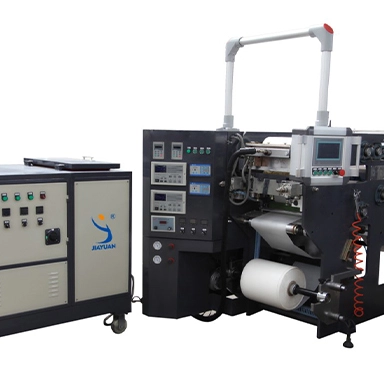
Tape manufacturing requires precision coating heads capable of handling aggressive pressure-sensitive adhesives. Slot die systems provide uniform, streak-free adhesive application, which is mandatory for optical clarity in clear tapes. They handle high-viscosity hot melts efficiently by utilizing internal distribution manifolds that balance fluid pressure across the die width. Edge guiding systems maintain perfect web alignment at high speeds, ensuring the adhesive is applied exactly to the edge of the substrate without bleeding onto the backing roller.
Inline coat weight measurement provides continuous quality control. Beta gauge or infrared sensors scan the web, feeding data back to the pump drive to adjust flow rates in real-time. A specialized adhesive tape coating machine ensures consistent tack and peel strength across every roll. You must also consider the unwind and rewind configurations; tape lines often require turret winders for continuous operation without stopping the line for roll changes.
Label production involves handling release liners and face stocks simultaneously. Precise differential tension control prevents curling, a common defect where the finished label stock bows toward the tighter web. You must manage the stretch characteristics of both materials independently using isolated tension zones. The release liner is typically coated with silicone, requiring the adhesive to wet out perfectly without migrating.
UV curing stations are often necessary for specific pressure-sensitive adhesives used in high-performance labels. A dedicated label coating laminating machine integrates chilling configurations to protect delicate paper or film face stocks from the heat generated by UV lamps or hot melt application. Moisture addition systems may also be required to re-humidify paper liners that dry out during the process, preventing brittleness and die-cutting issues downstream.
Closed-loop tension control systems prevent material distortion. Load cells measure actual web tension continuously, sending feedback to the PLC. Dancer rollers absorb sudden tension spikes during splicing or speed changes. Servo motors make micro-adjustments to the driven rollers to maintain flat, defect-free lamination. Proper web handling is the foundation of a reliable Hot Melt Laminating Machine. If your tension is wrong, no amount of adhesive precision will save the product.
Slot die coating offers precise metering for medium to high viscosities, utilizing custom shims to define the coating width and pattern. Gravure coating excels at applying very thin, low-viscosity layers, using engraved cylinders to transfer exact volumes of fluid. Multi-roll systems provide flexibility for changing adhesive types but require highly skilled operators to adjust nip pressures and roll speeds. Match your coating method to your required viscosity range and tolerance limits. Incorrect coating methods cause uneven adhesive distribution and massive scrap rates.
Evaluate single-operator versus multi-person operational designs. Ease of changeover reduces expensive machine downtime. Physical ergonomics matter during roll loading. Shaftless chucks reduce operator fatigue compared to heavy shafted systems, allowing a single operator to load multi-ton rolls safely. Safety guarding is non-negotiable for high-speed production runs. Light curtains, interlocked doors, and emergency stop pull cords must be integrated seamlessly into the machine frame.
Recipe management systems minimize changeover times. Operators load pre-set parameters for specific products instantly, adjusting temperatures, tensions, and pump speeds with one touch. Automated splicing via turret unwinds and rewinds keeps the line running continuously, eliminating the scrap associated with ramping the machine down and back up. Data logging helps track production metrics and operator error, providing a clear audit trail for quality control. Automation reduces scrap rates during startup phases and ensures lot-to-lot consistency.
Specify a machine frame that allows for future retrofitting. Modularity extends the lifespan of your capital equipment. You may need to add corona treaters later to improve adhesion on low-surface-energy plastics. Web cleaners remove dust and debris before coating, preventing pinholes in the adhesive layer. Secondary coating stations allow for complex, multi-layer products in a single pass. A well-planned custom coating production line adapts to changing market demands without requiring a complete line replacement.
Evaluate how custom lines integrate with your existing equipment. Upstream extrusion processes must sync with laminator line speeds using accumulator systems to buffer speed mismatches. Downstream slitting and converting equipment requires precise tension hand-offs to prevent telescoping rolls. Disconnected systems cause material bottlenecks and increase handling damage as rolls are moved manually between disparate machines.
Address the spatial realities of custom lines early in the planning phase. Ensure adequate maintenance access around all critical components, allowing technicians to pull rollers or service pumps without dismantling the entire frame. Plan for necessary ventilation to remove fumes from the melt tank area. Material handling logistics dictate how raw rolls enter and finished rolls exit the area; overhead cranes or specialized forklifts require specific aisle widths and ceiling clearances. Poor facility planning leads to inefficient workflows and safety hazards.
Assess the supplier's ability to modify standard designs. Niche substrates often require custom web paths with specialized idler roller coatings to prevent scratching. Unique adhesive formulations demand specialized pumping infrastructure, such as hardened gears for filled adhesives. A standard machine rarely fits complex industrial applications perfectly. Your chosen coating laminating machine supplier must demonstrate strong engineering capabilities and a willingness to customize the fluid delivery and web handling systems.
Define strict criteria for a successful Factory Acceptance Testing (FAT). You must run your actual materials and adhesives during the test, not generic substitutes. Operate the machine at full production speeds before authorizing shipment. Validate coat weight consistency across the web and verify tension control during splicing sequences. Never skip the FAT process; discovering a fundamental design flaw after the machine is bolted to your floor is a career-ending mistake.
Evaluate spare parts availability and lead times. Remote diagnostic capabilities allow engineers to troubleshoot PLC issues instantly, often resolving faults without a site visit. Review the supplier's service agreement for technician dispatch times. Reliable aftermarket support prevents minor issues from becoming catastrophic production delays. Ask for references from existing customers specifically regarding their experience with the service department.
Facility upgrades are often necessary before installation. High-amperage power drops must match the heating requirements of melt tanks and heated hoses. Compressed air quality affects pneumatic tension controls; moisture or oil in the air lines will destroy sensitive proportional valves. Structural floor requirements must support heavy machinery without shifting, requiring core drilling and specialized epoxy anchors. Complete all site preparation before the equipment arrives to avoid installation delays.
Advanced tension and thermal controls require significant operator training. The learning curve is steep for personnel used to older, mechanically driven equipment. Emphasize the need for comprehensive, on-site vendor training covering both operation and basic troubleshooting. Operators must understand how to navigate the HMI, adjust PID loops for temperature control, and thread the machine safely. Poor training leads to high scrap rates and damaged equipment.
Establish a realistic preventative maintenance schedule immediately. Filter changes prevent adhesive blockages in the die, which cause streaks in the coating. Die lip cleaning ensures a perfect fluid curtain. Roller resurfacing maintains even nip pressure across the web, preventing wrinkles and uneven bonding. Consistent maintenance prevents unexpected downtime and extends machine life.
Inspect and clean slot die lips daily using brass tools to prevent scoring the steel.
Calibrate load cells quarterly to ensure tension readouts remain accurate.
Flush the adhesive delivery system during extended shutdowns to prevent cross-linking in the hoses.
Check chill roll rotary unions for leaks weekly to prevent water damage to the web.
Choosing the right machine requires balancing material specifications, required throughput, and available capital. Prioritize substrate compatibility first to ensure basic functionality; if the machine cannot handle your thinnest film without stretching it, nothing else matters. Select your adhesive technology second based on performance needs and environmental constraints. Evaluate automation and speed third to optimize labor and output.
Gather physical samples of all primary and secondary substrates for vendor testing.
Define your exact GSM tolerances and acceptable variance limits for the adhesive layer.
Initiate technical consultations with shortlisted OEMs to review preliminary line layouts.
Audit your facility's electrical and spatial capacity before finalizing machine dimensions.
A: Slot die systems extrude adhesive through a precise gap, offering excellent coat weight control for medium to high-viscosity adhesives. They are closed systems, preventing contamination. Roll coating uses rotating cylinders to transfer adhesive. It is simpler to set up but struggles with high-viscosity fluids and precise GSM control.
A: Correct tension depends on the material's tensile strength, elasticity, and thickness. You calculate the required pounds per linear inch (PLI) for your specific substrate. Closed-loop load cell systems continuously monitor this tension, signaling servo drives to adjust speed and maintain the exact PLI required without stretching the web.
A: Yes, it can process temperature-sensitive substrates if configured correctly. You must utilize large-diameter chill rollers immediately after the lamination nip. Precise thermal isolation techniques prevent heat from radiating onto the incoming web. Fast line speeds also reduce the substrate's exposure time to the heated adhesive.
A: Lead times typically range from six to ten months. This includes the initial engineering and design phase, raw material procurement, and manufacturing. The timeline also accounts for assembly, internal testing, and the comprehensive Factory Acceptance Testing (FAT) using your specific substrates before final crating and shipment.
A: Transitioning requires removing large drying ovens and VOC abatement systems, freeing up floor space. You must work with adhesive suppliers to formulate a hot melt alternative that matches your previous solvent bond strength. Operators will need retraining to manage melt tanks, heated hoses, and thermal safety protocols.
A: A comprehensive warranty should cover all major mechanical components, including servo motors, drives, and PLC hardware. It must guarantee the heating and pumping infrastructure against premature failure. Ensure the warranty clearly defines the coverage period, typically one to two years, and outlines the terms for remote software support.


