
Views: 0 Author: Site Editor Publish Time: 2026-10-12 Origin: Site


The global demand for aluminum foil butyl waterproof tape is surging. Construction and roofing sectors are rapidly adopting this material to meet stringent new building codes. Recent industry shifts heavily emphasize energy efficiency and long-term weatherproofing. Extreme climate events constantly expose the flaws in traditional acrylic or asphalt sealants. Contractors now demand solutions that will not degrade under harsh UV rays or brutal freeze-thaw cycles. Consequently, manufacturers are scaling up production to meet this lucrative market gap.
Processing high-viscosity non-curing elastomers requires serious hardware. Factory managers and production engineers face a tough equipment market. Balancing capital expenditure with operational stability is rarely straightforward. Decision-makers often struggle to find machinery that guarantees continuous output without sacrificing coating precision. This technical guide provides a clear roadmap for selecting the exact machinery required for your manufacturing facility.
Key Takeaways
Extrusion precision directly dictates product viability and market acceptance.
Die head engineering and closed-loop web tension control prevent foil deformation.
Investing in a highly automated butyl rubber coating production line drastically cuts raw material waste.
Thermal management determines continuous running speed and long-term profitability.
Equipment must handle diverse foil thicknesses and custom rubber formulations seamlessly.
Evaluating machinery means understanding the behavior of the raw materials. Standard pressure-sensitive adhesives flow easily. Butyl rubber does not. It is a synthetic elastomer boasting extreme viscosity and zero curing time. It blocks moisture and gases exceptionally well. You cannot apply this thick material with standard roller coaters. It demands high-pressure thermal extrusion to achieve the correct flow characteristics.
The process starts by feeding solid butyl blocks into a specialized heating barrel. The polymer melts and homogenizes under immense pressure. The system forces it through a precision slot die head. The machine extrudes this hot mass directly onto a moving aluminum foil substrate or a silicone release liner. Heavy-duty lamination rollers immediately compress the layers together. Rapid cooling cylinders then drop the temperature. This stabilizes the rubber before the final product is rewound into master rolls. If you attempt to run this process on a standard adhesive coater, the machine will jam. You need a dedicated butyl rubber extrusion coating machine designed specifically for high thermal loads and heavy polymer displacement.
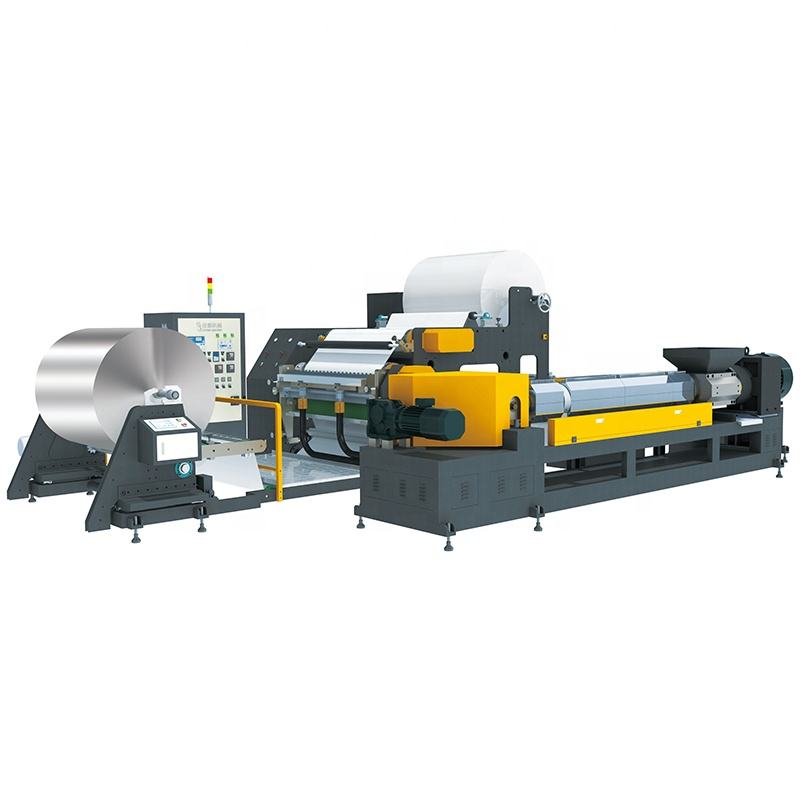
Inspecting the metal is the only way to evaluate different models. The durability of these core components dictates your factory's uptime and overall output quality.
The extruder is the engine of the entire setup. Single-screw extruders handle standard pre-compounded butyl blocks perfectly. Twin-screw setups offer aggressive mixing capabilities if your factory plans to add specific tackifiers inline. Quality barrels feature multiple independent temperature zones. Precise thermal management prevents material scorching while maintaining the exact viscosity required for a smooth application.
This is where the engineering truly matters. The internal manifold of the die must distribute the heavy polymer melt evenly across the entire web. High-end machines utilize adjustable die lips. Operators can dial in the exact coating thickness and width. This mechanical flexibility ensures an even spread and eliminates messy edge build-up.
Aluminum foil tears and wrinkles easily under the wrong tension. Dual-station unwinding units keep the line moving during roll changes. Top-tier equipment integrates magnetic powder brakes and closed-loop servo motors. These systems maintain flawless web tension from the start of the roll to the very end.
Comparing quotes requires looking at hard data. Verify the engineering specs to ensure the machine meets your production targets.
Daily output drives your revenue. Standard lines run between 10 and 30 meters per minute. Advanced setups can push higher speeds without losing cooling efficiency. Your chosen capacity must align closely with local market demand and your facility's operational shifts.
Waterproof tapes need thick adhesive layers to bridge gaps in roofing materials. Standard applications require 0.5mm to 1.5mm. Heavy-duty tapes demand up to 2.0mm. Your equipment must hold a strict thickness tolerance of ±0.05mm. Inconsistent application wastes expensive raw materials and ruins the waterproofing performance.
Check the maximum web width capabilities. Models typically offer 500mm, 1000mm, or 1200mm working widths. The machine must handle pure soft-temper foil, PET-laminated foil, and various release papers without causing surface scoring.
To clarify the technological leap, review the core differences between equipment types.
Specification | Standard Adhesive Coater | Specialized Butyl Extrusion Line |
|---|---|---|
Adhesive State | Liquid / Low Viscosity | Solid Block / High Viscosity |
Application Method | Roller Coating / Anilox | Precision Slot Die Extrusion |
Heating Capacity | Low to Medium | High with multiple independent zones |
Coating Thickness | 0.02mm - 0.15mm | 0.5mm - 2.0mm |
Tension Control | Basic Mechanical | Closed-loop Servo and Magnetic Powder |
Modern floor operations rely heavily on smart controls. Reducing human error directly improves your bottom line. When assessing a butyl waterproof tape production machine, scrutinize the electronic control architecture.
Reliable Programmable Logic Controllers run the show. Look for intuitive touch screens featuring recipe storage. Production managers can save specific temperature profiles and tension settings for different tape specifications. Operators switch between product runs instantly without manual recalibration.
Material handling must be seamless to minimize downtime. Edge Position Control systems use ultrasonic sensors to track the moving web. They adjust alignment in real-time. This keeps the foil and release paper perfectly synchronized. Furthermore, automatic splicing technology allows non-stop roll changes at full production speed.
Industrial extrusion equipment is a massive capital expenditure. The machine must survive constant operation in harsh environments. Extruding high-viscosity rubber generates immense mechanical stress. The chassis must be built from heavy-duty solid steel. A rigid frame absorbs high-speed vibrations, safeguarding the microscopic precision of the slot die.
Butyl is applied at temperatures exceeding 120°C and must cool rapidly. A high-efficiency chilled water roller system is non-negotiable. Double-jacketed rollers circulate cold water to drop the web temperature instantly. This prevents the non-curing tape from oozing out of the sides or sticking to the rewinding shafts.
Component sourcing matters greatly. Verify the manufacturer uses internationally recognized brands for bearings, motors, and electrical contactors. This ensures long-term reliability and painless local procurement for spare parts.
Financial viability drives the final decision. Budget-friendly machines look tempting on paper. However, calculating the Total Cost of Ownership reveals the true financial impact.
Cheap machines hide long-term costs. Poor temperature control and sloppy tension management cause constant mechanical breakdowns. Unscheduled downtime and delayed shipments destroy profit margins. A premium machine minimizes disruptions and guarantees steady revenue generation over a decade of use.
Heating elements and drive motors consume massive electrical power. High-end equipment features heavily insulated heating zones to prevent thermal loss. Energy-efficient servo motors draw power only when actively needed. These engineering upgrades slash daily operational expenses.
Raw materials dominate ongoing manufacturing costs. Precise tension control and automated defect detection drastically reduce scrap during startup and continuous running. Saving just a fraction of a percent on material waste translates to massive annual savings. An efficient line pays for itself through material conservation alone.
Your machinery supplier is a long-term technical partner. Vet them rigorously. Demand a Factory Acceptance Test before authorizing final payment. The manufacturer must run the machine at full speed using your exact raw materials to prove performance.
Installation requires specialized engineering knowledge. The supplier must provide comprehensive on-site commissioning or highly detailed remote guidance. Operator training should cover strict safety protocols, standard running procedures, and basic troubleshooting.
A solid warranty is essential for major components. The manufacturer must also guarantee the long-term availability of consumable parts like die lips and heating elements. Supply chain issues should never cause a factory shutdown.
Selecting the optimal equipment elevates product quality and secures a strong competitive edge. Evaluate your specific production targets carefully. For reliable, high-performance machinery tailored to your exact factory specifications, explore the advanced engineering solutions at JY-WELL and consult with our technical team today.
Standard coaters handle low-viscosity liquid adhesives using simple roller mechanisms. Butyl rubber is a highly viscous solid at room temperature. It requires a heavy-duty heated screw extruder to melt and push the material through a precision slot die under extreme pressure.
Yes. High-quality lines feature modular designs. By adjusting the unwinding stations and utilizing dual silicone release liners instead of an aluminum foil backing, the machine easily switches to producing double-sided sealing tape.
Modern PLC automation and auto-tension controls streamline the entire process. A standard continuous line typically requires only one or two trained operators. They monitor the HMI screen, load raw material rolls, and unload finished products.
Strict routine maintenance ensures coating uniformity. Operators must purge the extruder of residual rubber before shutdowns. Cleaning the die lips with brass tools prevents internal scoring. Regular inspections of internal heating elements ensure uniform temperature distribution.
Wrinkling is prevented through advanced web handling technology. The equipment utilizes closed-loop servo motors combined with magnetic powder brakes to maintain ultra-precise tension. Edge Position Control sensors continuously monitor and correct the web alignment before lamination occurs.
Energy consumption varies by machine size and production speed. A standard 1000mm width line typically requires an installed power capacity between 80kW and 120kW. Actual running consumption is usually 60% to 70% of the installed power due to insulated heating zones and variable frequency drives.


